In this article
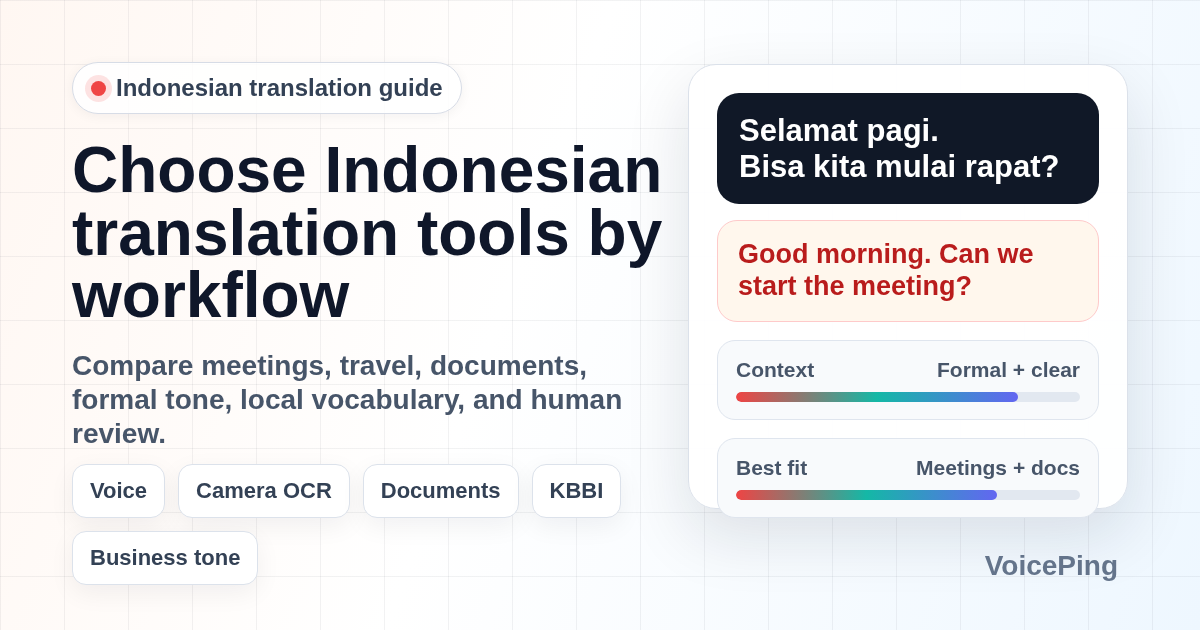
Compare Indonesian translation tools for business meetings, travel, documents, learning, formal tone, KBBI checks, and high-risk human review. Covers VoicePing, Google Translate, Microsoft Translator, DeepL, Papago, KBBI, dictionaries, and learning tools.
Last updated: April 26, 2026.
Indonesian translation looks simple at first because Bahasa Indonesia uses the Latin alphabet and has fewer verb inflections than many European languages. In real work, the hard parts are different: formal vs. informal tone, affixes, loanwords, local vocabulary, mixed Indonesian-English speech, and choosing when a machine draft needs a human reviewer.
This guide replaces the old app-list format with a practical 2026 workflow guide. It covers business meetings, travel, camera OCR, document drafts, learning, and high-risk review. Feature claims that can change over time are tied to current vendor documentation, while VoicePing recommendations are labeled as product-fit guidance rather than independent benchmark results.
Quick Recommendations
| Job to be done | Start with | Why |
|---|---|---|
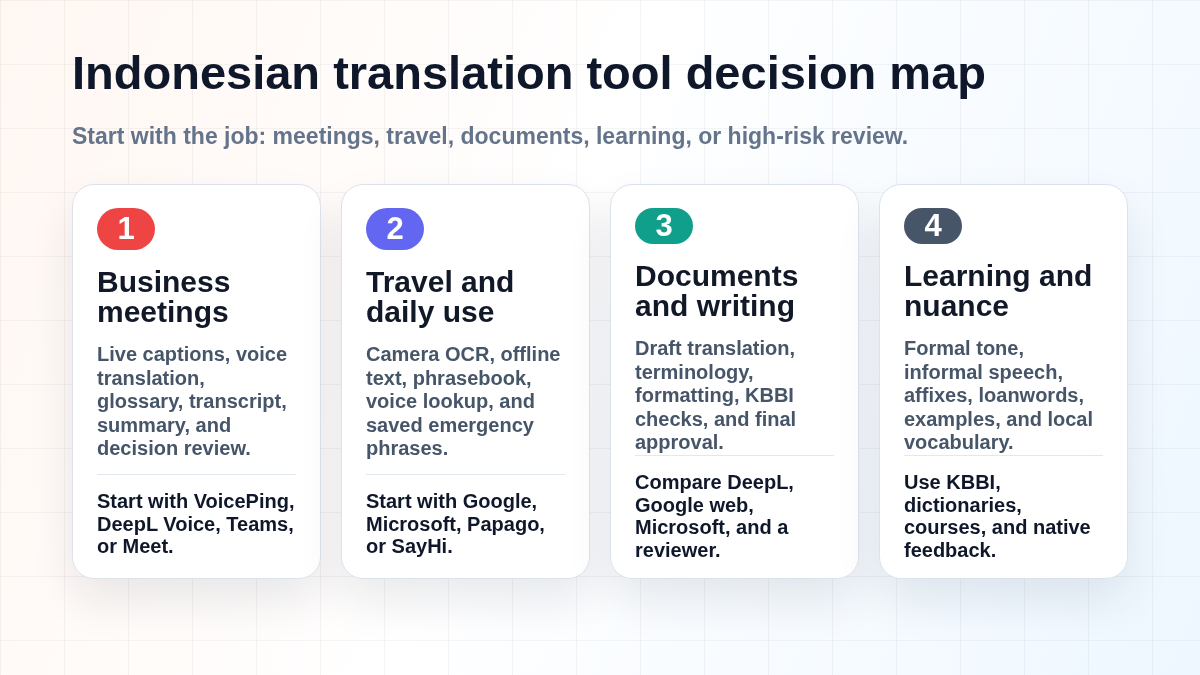
| Indonesian business meetings | VoicePing , DeepL Voice, or your conferencing stack | Live captions, transcript, glossary, summary, and decision review matter more than one-off phrase translation. |
| Travel and daily lookup | Google Translate , Microsoft Translator , Papago, or SayHi | Camera OCR, speech lookup, phrasebooks, offline text, and saved emergency phrases are the practical travel features. |
| Documents and business writing | DeepL Translator , Google web, Microsoft Translator, KBBI, and human review | Written Indonesian needs terminology checks, formatting review, and tone approval. |
| Learning and nuance | KBBI , Indonesian dictionaries, courses, and native feedback | Learners need word formation, examples, formal usage, informal speech, and local vocabulary support. |
| Japanese-Indonesian operations | VoicePing, Mirai Translate, VoiceTra, Weblio, and bilingual reviewers | Japan-Indonesia workflows often need meeting notes, Japanese source clarity, and local HR or manufacturing terminology. |
| Legal, medical, HR, contracts | Qualified human translator or interpreter | AI can support drafting, but final accountability should stay with a qualified reviewer. |
What Changed Since Older Indonesian App Lists
Older Indonesian translation app articles often focus on old app-store rankings, exact monthly prices, or Japan-only market statistics. That does not help a team choose the right tool in 2026.
Three current realities matter:
- General translation apps cover more modes. Google Translate highlights camera translation, offline language downloads, conversation, transcribe, document translation, and website translation. Google’s offline help says downloaded languages can be used without an internet connection and may support camera translation.
- Microsoft lists Indonesian across key modes. Microsoft Translator’s language page lists Indonesian support for text, speech, image, text-to-speech, multi-device conversation, and Android offline packs.
- DeepL support is now broader than older articles suggest. DeepL’s current Translator help lists Indonesian among supported languages, and DeepL Voice documentation lists Indonesian as both a spoken transcription language and a translated caption language for meetings.
The practical takeaway: choose the tool by workflow, then test it with the actual Indonesian speakers, documents, terminology, and devices your team will use.
How to Evaluate Indonesian Translation Tools
Use this checklist before choosing a tool for work.
| Area | What to check |
|---|---|
| Input mode | Text, camera OCR, speech, multi-device conversation, meeting captions, document upload, or API. |
| Formality | Whether the tool produces formal business Indonesian or casual chat Indonesian. |
| Terminology | Product names, factory terms, customer names, HR terms, safety phrases, acronyms, and glossary support. |
| Mixed speech | Whether it handles Indonesian-English code-switching and local workplace expressions. |
| Local vocabulary | Whether the phrase is standard Bahasa Indonesia, Jakarta colloquial speech, or a regional-language loanword. |
| Audio quality | Microphone placement, background noise, overlapping speakers, and factory or event conditions. |
| Offline behavior | Whether offline mode covers text, camera images, phrasebook, or only specific downloaded packs. |
| Review path | Who approves the final wording before customers, employees, patients, or regulators see it. |
Best Indonesian Translation Tools by Use Case
1. VoicePing for Indonesian Business Meetings
VoicePing fits Indonesian workflows where translation must become a usable business record: real-time interpretation, transcript, meeting summary, and follow-up review. VoicePing’s site describes real-time voice translation, transcription, and AI meeting summarization, which is the right category for recurring business meetings, supplier calls, customer meetings, and hybrid events.
Use VoicePing for:
- Indonesian-English or Indonesian-Japanese meetings with customers, distributors, factories, or overseas teams.
- Calls where action items, decisions, and summaries need to be reviewed after the meeting.
- Events or seminars where attendees need translated captions from their own devices.
- Teams that need translation and meeting notes in the same workflow.
Product opinion: VoicePing is strongest when the meeting record matters. For casual travel or a quick sign lookup, a mobile translation app is usually faster.
2. Google Translate for Travel, Camera OCR, and Fast Lookup
Google Translate is a strong first download for Indonesia travel because it combines camera translation, conversation mode, speech, handwriting, saved phrases, document translation, and website translation. Google’s help page also says downloaded languages can be used without internet, and downloaded languages may support camera translation.
Use it for:
- Menus, signs, transport instructions, hotel messages, forms, and product labels.
- Quick Indonesian-English phrase lookup.
- Camera OCR when typing from a sign or printed form is slow.
- Saving emergency phrases, allergy notes, addresses, and ride-share instructions.
Limitations: offline behavior differs by language, device, and feature mode. Test text, camera, and speech separately before relying on them in an airport, remote site, factory, or clinic.
3. Microsoft Translator for Multi-Device Conversation
Microsoft Translator is useful when you need text, speech, image translation, text-to-speech, multi-device conversation, and Android offline packs in one Microsoft-friendly tool. Its language page lists Indonesian support across those feature columns.
Use it for:
- Group conversations where participants join from their own devices.
- Indonesian image translation and speech lookup.
- Microsoft-centric teams that prefer Microsoft account and security controls.
- A backup app when Google Translate is unavailable or users prefer another interface.
Limitations: Microsoft’s Android FAQ says offline packs can support text translation, camera translation, phrasebooks, and pinned translations, but live conversation and microphone-based speech translation are not available offline.
4. DeepL for Documents and Meeting Captions
DeepL Translator lists Indonesian among its supported languages. DeepL Voice also lists Indonesian as a spoken language transcribed by DeepL and as a caption translation language.
Use it for:
- Business email drafts, proposal drafts, policy drafts, and support articles.
- Comparing Indonesian document output against Google or Microsoft.
- Teams already using DeepL for multilingual writing workflows.
- Meeting-caption comparisons when your security and procurement teams approve the setup.
Limitations: verify Indonesian availability in the exact DeepL product, plan, and mode you plan to use. Web translation, document translation, API, glossary, and voice products do not always have identical feature sets.
5. Papago for Asian-Language Travel and Backup Translation
Papago’s Google Play listing says it supports 14 languages, including Indonesian, and lists text, image, voice, offline, conversation, handwriting, website, and dictionary features.
Use it for:
- A second opinion on short Indonesian phrases.
- Travel situations where the mobile interface is faster for one-to-one exchange.
- Asian-language workflows where Korean, Japanese, Chinese, Vietnamese, Thai, or Indonesian appear together.
Limitations: Papago is useful as a travel and backup translator, but it is not a replacement for business review, legal review, or a meeting transcript workflow.
6. KBBI for Standard Indonesian Checks
KBBI Daring is the official online Indonesian dictionary. It is useful when a machine translation produces a fluent sentence but you need to check whether a word is standard, formal, or appropriate for a public document.
Use KBBI for:
- Checking standard Indonesian word forms.
- Reviewing formal terms before publishing policy, HR, or customer-facing copy.
- Confirming whether a loanword or spelling is accepted.
- Training non-native writers to rely less on one-click machine output.
Limitations: a dictionary does not solve sentence-level tone, regional nuance, or legal meaning. Use it as a reference layer, not the final reviewer.
7. Mirai Translate, VoiceTra, and Japanese-Indonesian Workflows
For Japanese companies working with Indonesia, Japanese-Indonesian translation has its own risks. Japanese source sentences often omit the subject, rely on context, and use company-specific phrasing. Indonesian output may look clear but still miss who is responsible, what deadline applies, or whether the tone is instruction, request, or confirmation.
Use Japan-focused tools and bilingual reviewers for:
- Manufacturing instructions, HR announcements, and safety training.
- Japanese meeting notes that need Indonesian follow-up.
- Customer or supplier emails where Japanese source ambiguity must be resolved first.
- Final review of Indonesian copy created from Japanese.
Product opinion: if the work begins as a meeting, start by capturing the meeting accurately. Translation quality improves when the source transcript, speaker intent, and terminology are clear.
8. SayHi, iTranslate, and Simple Conversation Apps
Conversation-first apps can be useful for low-risk travel. The advantage is speed: open the app, speak, play the result, and move on.
Use them for:
- Ordering food, asking directions, and confirming pickup times.
- Casual one-to-one conversation where a transcript is not needed.
- A backup interface if another app feels too complex for a quick exchange.
Limitations: travel apps usually do not provide glossary control, admin controls, meeting summaries, or review workflows. Keep them out of high-risk decisions.
9. Learning Apps, Courses, and Native Feedback
Learning tools are not translation tools, but they help you stop overusing translation tools. Indonesian learners need to understand affixes, passive voice, particles, formal vs. informal wording, and common loanwords.
Use learning tools for:
- Building travel phrases before a trip.
- Learning formal greetings and polite business closings.
- Understanding prefixes and suffixes such as me-, di-, ber-, -kan, and -i.
- Getting tutor or native-speaker feedback on whether a phrase sounds natural.
For business users, a small set of Indonesian greetings and closing phrases improves trust. “Selamat pagi” for good morning and “terima kasih” for thank you are simple but useful.
10. Human Translators and Interpreters
Human review remains the best option when misunderstanding has legal, financial, medical, safety, or employment consequences. AI translation can reduce preparation time, but it should not own the final decision.
Use human review for:
- Contracts, employment documents, and compliance notices.
- Medical instructions, consent forms, and patient conversations.
- Factory safety training, emergency procedures, and technical specifications.
- Public marketing claims, investor documents, and government filings.
Indonesian-Specific Translation Risks
Formal vs. Informal Indonesian
Business Indonesian can be direct, but it still needs the right level of formality. A casual phrase that works in chat may sound unprofessional in HR, procurement, or customer support. Ask a native speaker to review customer-facing copy, especially if the translation came from casual English or Japanese source text.
Affixes and Passive Voice
Indonesian word meaning can change through prefixes and suffixes. Passive construction is also common. Machine translation may produce a fluent sentence while changing who acts, who receives the action, or whether the sentence is a command. Check responsibility and deadline wording carefully.
Local Vocabulary and Code-Switching
In workplaces, speakers may mix Indonesian, English, Japanese, and local-language terms. A translation app may misread acronyms, product names, and local shorthand as ordinary words. Add a glossary before recurring meetings.
Names, Numbers, and Addresses
Translation tools are weakest when a single character or digit matters. Confirm names, phone numbers, prices, dates, bank details, room numbers, addresses, and product codes manually.
Best Tool Stacks
Indonesian Business Meeting Stack
Use VoicePing for live interpretation, transcript, and summary. Prepare a glossary for company names, product names, factory terms, and acronyms. Use a bilingual reviewer for external follow-up.
Indonesia Travel Stack
Download Google Translate and one backup app before departure. Save hotel addresses, ride-share instructions, allergy notes, emergency phrases, and screenshots. Test camera OCR on Indonesian signs while you still have connectivity.
Indonesian Document Stack
Use DeepL, Google, or Microsoft for a draft, then check important terms in KBBI and your internal glossary. For HR, legal, medical, regulatory, or safety content, send the final version to a qualified Indonesian translator.
Learning Stack
Use KBBI and dictionary tools for word lookup, a course or tutor for grammar and pronunciation, and machine translation to compare full sentences. Do not use translation output as a substitute for understanding tone.
FAQ
What is the best Indonesian translation app?
For travel, start with Google Translate and keep Microsoft Translator or Papago as backup. For business meetings, use a meeting-focused workflow such as VoicePing, DeepL Voice, or your conferencing platform plus review. For documents, compare DeepL, Google, Microsoft, KBBI, and a human reviewer.
Is Indonesian easy for machine translation?
It can be easier than languages with a different script, but it is not automatically easy. Formality, affixes, passive voice, local vocabulary, and code-switching can change meaning. Test with your actual content.
Can translation apps handle Indonesian-English mixed speech?
Sometimes, but performance depends on audio quality, speaker habits, terminology, and whether the tool expects one source language. For meetings, test with your real speakers and glossary before rollout.
Is offline Indonesian translation enough for travel?
Offline text is useful, but offline behavior differs by app and feature. Download packs in advance, then test text, camera, and speech separately. Keep key phrases and addresses saved as text and screenshots.
Should I use a human translator for Indonesian contracts?
Yes. Use AI for drafting or comparison, but have a qualified Indonesian translator or legal reviewer approve contracts, compliance notices, HR documents, medical instructions, and safety procedures.
Related Guides
- Best Voice Translation Apps in 2026
- Best Automatic Meeting Transcription Tools
- AI Event Translation Tools
- Best English Translation Tools
- VoicePing Event Translation App