In this article
Learn how offshore development works in 2026, when to use it, what risks to control, and how to manage remote vendors across time zones.
Last updated: April 26, 2026. This guide was refreshed with current IT spending, software industry, developer work, tech talent, remote-work, and VoicePing documentation sources. Vendor pricing, product features, free plans, and outsourcing market data change often, so verify official pages before making a purchasing or staffing decision.
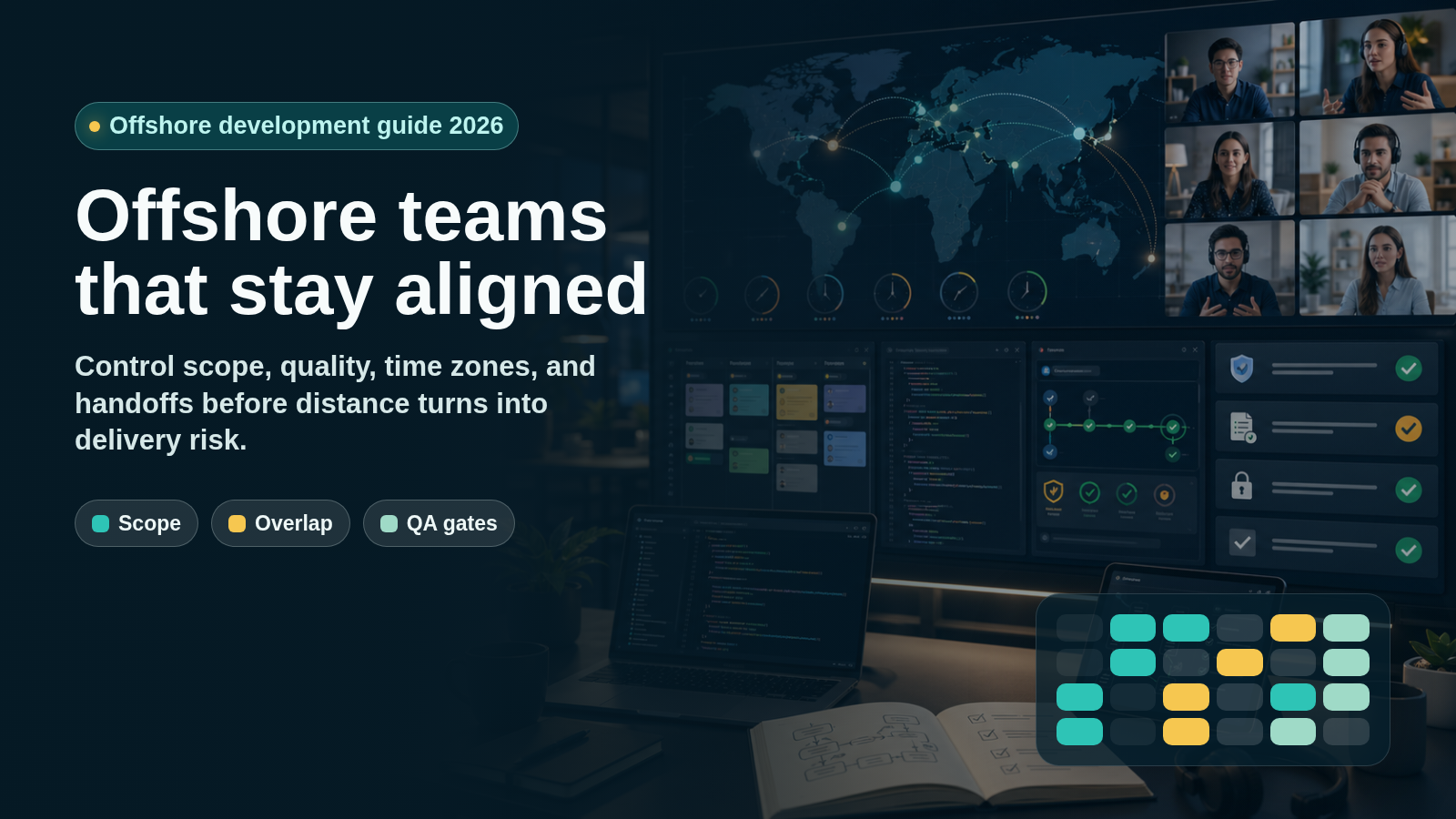
Offshore development means working with software engineers, QA specialists, designers, DevOps staff, or a development vendor in another country, often far enough away that time zones, language, culture, security, and handoffs need deliberate management.
The old reason for offshore development was simple: lower labor cost. That is still part of many business cases, but it is not enough in 2026. Global software work now sits inside a market shaped by AI-assisted development, cybersecurity controls, remote-work expectations, and persistent tech talent shortages. Gartner forecasts worldwide IT spending will reach $6.15 trillion in 2026, while Deloitte’s 2026 software outlook describes a software market being reshaped by AI agents, cloud platforms, governance, and enterprise security.
Stanford SIEPR’s 2025 work-from-home analysis reports that work-from-home levels have stabilized since 2023, and WFH Research’s January 2026 update continues to track hybrid and fully remote work as a durable part of the labor market. Offshore development should therefore be managed as a deliberate distributed operating model, not as an exception to normal teamwork.
That changes the question. Instead of asking “can we hire offshore developers cheaply?” leaders should ask “can we create a remote delivery system that protects scope, quality, security, IP, and product knowledge?”
What Is Offshore Development?
Offshore development is a form of outsourcing where the vendor or engineering team is based in a different country, often on another continent. The offshore team may build a complete product, extend an internal engineering team, handle QA, provide DevOps support, or deliver a specialized capability the company does not have in-house.
Offshore development is not the same as handing over responsibility for the whole product. The client still needs product ownership, technical direction, acceptance criteria, security rules, documentation standards, and a clear decision process.
Offshore vs. Nearshore vs. Onshore Development
| Model | What it means | Typical advantage | Main tradeoff |
|---|---|---|---|
| Onshore development | Vendor is in the same country or region | Easier communication, legal familiarity, similar working hours | Usually higher cost and smaller talent pool |
| Nearshore development | Vendor is in a nearby country or compatible time zone | Better overlap than offshore, often lower cost than onshore | Still needs cultural, legal, and delivery alignment |
| Offshore development | Vendor is in a farther country or time zone | Broader talent access, capacity, specialist skills, potential cost advantage | More risk around time zones, communication, quality, security, and handoff |
The best option depends on the work. A security-sensitive architecture project may need onshore or tightly controlled nearshore collaboration. A well-specified QA, mobile development, migration, or maintenance project may fit offshore delivery well.
Why Companies Use Offshore Development in 2026
Access to Specialized Talent
Offshore development can help teams find skills that are scarce locally: cloud migration, mobile engineering, AI integration, QA automation, DevOps, security testing, multilingual product support, or legacy modernization. The OECD notes that demand for skilled tech professionals continues to outpace supply, which makes talent access a strategic reason to look beyond local hiring.
Flexible Capacity
Many teams do not need a permanent full-time hire for every specialist skill. Offshore partners can provide capacity for a release, migration, proof of concept, support queue, or product expansion.
Cost Control
Offshore development can reduce direct labor cost, but it is not automatically cheaper. The real cost includes vendor management, onboarding, documentation, meetings, QA, security reviews, legal review, rework, travel, and internal product-owner time.
Use offshore development when the total delivery model is cheaper or better, not just when the hourly rate is lower.
Faster Coverage Across Time Zones
For some teams, time-zone distance is useful. A U.S. product team may hand off QA, monitoring, documentation, or support tasks to an overseas team while the U.S. team is offline. This only works when handoffs are documented and ownership is clear.
Global Product Perspective
An offshore team can bring language, market, accessibility, payment, localization, or regional device knowledge that the core team may lack. This is especially valuable for products serving multiple countries.
When Offshore Development Is a Good Fit
Offshore development is usually a strong candidate when:
- The work can be described with clear outcomes and acceptance criteria
- A product owner or technical lead can stay accountable internally
- The team can create written specifications, backlog items, and design decisions
- There is enough time-zone overlap for planning, demos, and escalation
- The work can be reviewed through code review, tests, demos, or measurable deliverables
- Security and IP terms can be made explicit before access is granted
- The project needs skills or capacity that are hard to hire locally
Good offshore candidates include QA automation, feature development in a mature codebase, mobile app work, data migration, technical support tooling, localization engineering, documentation, and maintenance work with defined boundaries.
When Offshore Development Is Risky
Offshore development is risky when:
- The product strategy is unclear
- Requirements change daily without a product owner
- The internal team cannot review technical work
- The project depends on sensitive data without strong access controls
- There is no acceptance testing process
- The vendor owns critical knowledge that is not documented
- The company is choosing offshore only because the hourly rate looks low
- Communication depends entirely on live meetings with almost no overlap
In those cases, fix the operating model before signing a vendor contract.
Offshore Development Models
Staff Augmentation
You add offshore engineers to your internal team. This works when you already have strong product management, architecture, code review, and engineering rituals.
Best for: increasing capacity under internal leadership.
Watch out for: treating augmented staff as owners without giving them context or decision rights.
Dedicated Offshore Team
You hire a stable team through a vendor or offshore partner. The team may include engineers, QA, designers, and a delivery manager.
Best for: longer product roadmaps, ongoing development, and predictable capacity.
Watch out for: vendor lock-in if architecture, runbooks, and product decisions are not documented.
Managed Project
The vendor owns delivery of a defined project. This can work when requirements, timelines, scope, and acceptance criteria are stable.
Best for: contained builds, migrations, prototypes, or systems with clear deliverables.
Watch out for: change requests, quality disagreements, and unclear handoff at the end.
Specialist Partner
You hire offshore expertise for a specific skill, such as security testing, AI integration, DevOps, mobile development, or localization engineering.
Best for: work where internal knowledge is limited.
Watch out for: security permissions, review quality, and knowledge transfer.
How to Manage Offshore Development
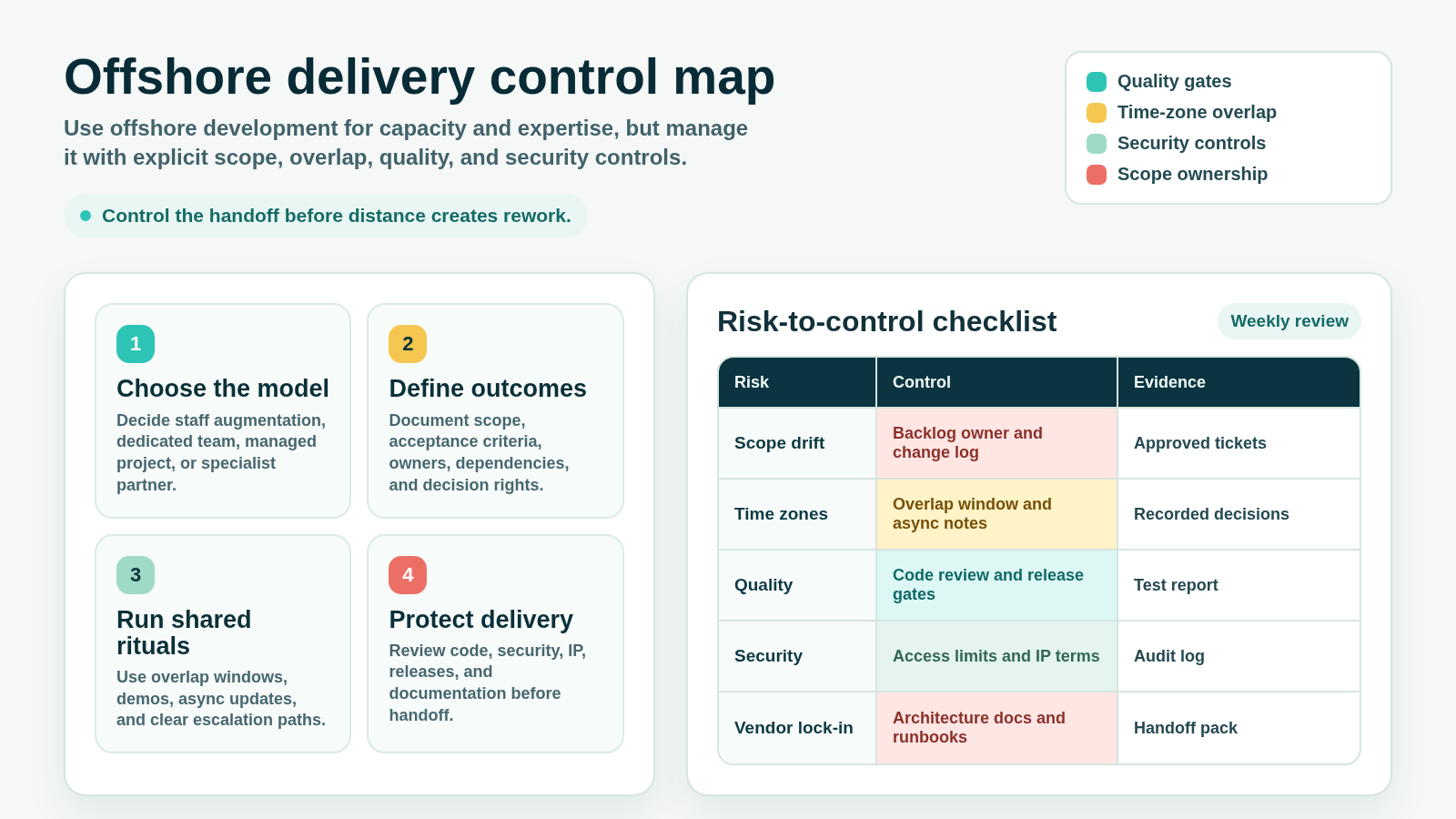
1. Keep Product Ownership Internal
The vendor can build, test, and advise. Your company should still own product priorities, customer context, technical direction, release decisions, and acceptance criteria.
Assign:
- Product owner
- Technical lead or architect
- Vendor delivery owner
- Security or compliance owner
- QA or acceptance owner
- Escalation path for blocked decisions
2. Define Scope Before Work Starts
Offshore delivery fails quickly when requirements live only in calls. Create written scope and keep it updated.
Minimum documentation should include:
- Problem statement
- User stories or functional requirements
- Nonfunctional requirements
- Acceptance criteria
- Definition of done
- Dependencies
- In-scope and out-of-scope items
- Change request process
- Target milestones
The goal is not heavy paperwork. The goal is to make decisions visible when people are not online at the same time.
3. Set Overlap Windows
Time-zone distance does not require everyone to be online all day. It does require predictable overlap for high-value conversations.
Use overlap time for:
- Sprint planning
- Technical design decisions
- Blocker escalation
- Demos
- Retrospectives
- Sensitive feedback
Move status updates, routine questions, and handoff notes into written async channels. Stack Overflow’s 2025 developer survey reports that many developers already work remotely and use a large number of tools, so offshore teams should avoid adding unnecessary meeting and tool sprawl.
4. Make Quality Gates Explicit
Do not wait until final delivery to check quality. Build gates into the workflow:
- Code review by both vendor and internal leads
- Automated tests for critical paths
- Security checks before production access
- Demo at the end of each milestone
- Test reports for accepted work
- Release checklist
- Rollback plan
- Documentation review
Quality control should be routine, not a confrontation at the end of the project.
5. Protect Security and IP
Offshore development can be secure, but only if access is controlled deliberately.
Before sharing systems or data, confirm:
- Contract terms for IP ownership
- NDA and confidentiality requirements
- Data processing and privacy obligations
- Least-privilege access
- Device and network rules
- Source control permissions
- Secrets management
- Audit logging
- Offboarding process
- Restrictions on AI tools and customer data
Deloitte’s 2026 software outlook highlights governance and enterprise-grade infrastructure as software work becomes more AI-assisted. That matters for offshore teams because AI coding tools, code repositories, test data, and customer information can create new leakage and compliance risks.
6. Document Architecture and Handoffs
Vendor lock-in often happens because the vendor understands the system and the client does not. Reduce that risk with a handoff pack:
- Architecture overview
- Environment setup guide
- Deployment steps
- Runbooks
- API and data model notes
- Testing strategy
- Known limitations
- Release history
- Pending technical debt
- Ownership map
Documentation should be reviewed as a deliverable, not treated as a favor.
7. Use AI Carefully
AI-assisted coding can help offshore and in-house teams move faster, but it does not remove the need for review. Define an AI policy that covers:
- Whether AI coding tools are allowed
- Which repositories or data can be used
- Whether generated code must be labeled
- Review rules for AI-generated code
- License and security scanning
- Customer-data restrictions
The policy should apply to both internal and vendor teams.
8. Track Delivery Metrics
Useful offshore metrics include:
- Cycle time
- Escaped defects
- Reopened tickets
- Code review turnaround
- Test coverage on critical paths
- Blocker age
- On-time milestone completion
- Documentation completeness
- Security findings
- Handoff quality
- Internal team time spent managing rework
Do not judge the vendor by output volume alone. A high number of tickets can still hide weak quality or unclear ownership.
Common Offshore Development Mistakes
Choosing Only by Hourly Rate
The cheapest vendor can become expensive if the team creates rework, misses context, or leaves undocumented code behind. Compare total cost, not just rate cards.
Outsourcing Product Thinking Accidentally
If the internal team cannot explain the customer, business rules, edge cases, and release priorities, the offshore team will guess. Keep product decisions close to the business.
Scheduling Too Many Meetings
Offshore work needs communication, but more meetings are not always better. Use written handoffs, recorded demos, decision logs, and async updates so overlap time is used for real decisions.
Ignoring Language and Cultural Differences
Avoid vague instructions, idioms, and implied expectations. Write decisions clearly, confirm understanding, and make disagreement safe. The issue is not that one culture is better than another; the issue is that unspoken assumptions become defects.
Skipping Security Review
Security cannot be added after the vendor already has broad access. Put access controls, AI-tool rules, audit logs, and data restrictions in place before development begins.
Forgetting Maintenance
If the vendor builds the system but no one can maintain it, the project is incomplete. Require documentation, tests, runbooks, and knowledge-transfer sessions.
Where VoicePing Fits in Offshore Development
VoicePing is not an offshore vendor marketplace, project management suite, or software delivery platform. It supports the communication layer around remote and offshore teams.
VoicePing’s virtual office page currently describes features such as instant communication, speech recognition, automatic meeting minutes, voice translation, attendance management, customizable floors, cloud recording, team status visibility, productivity management, workspace feature settings, and event logs.
For offshore development teams, that can help with:
- Quick voice conversations when chat is too slow
- Meeting minutes and recordings for people in different time zones
- Transcription and voice translation for multilingual vendors and stakeholders
- Guest access for external collaborators
- Team status visibility without scheduling every interaction
- Time tracking and work logs where they fit company policy
Use these features to improve clarity and reduce handoff friction. They do not replace product ownership, code review, security controls, or vendor management.
Pricing and included allowances can change. The VoicePing pricing manual currently lists voice translation, virtual office, account limits, translation minutes, cloud recording, time tracking, trial availability, and enterprise options. Verify the current plan before rollout.
Offshore Development FAQ
Is offshore development the same as outsourcing?
Offshore development is one type of outsourcing. It specifically means software development work is done by a vendor or team in another country, often far from the client company’s time zone.
Is offshore development only about reducing cost?
No. Cost can matter, but offshore development is also used for specialist skills, flexible capacity, global coverage, localization knowledge, and faster scaling. The strongest business case includes delivery quality and risk controls, not only lower hourly rates.
What work should not be outsourced offshore?
Be careful with unclear product discovery, highly sensitive data, core architecture without internal review, emergency projects with no onboarding time, and work where no one inside the company can judge quality.
How often should offshore teams meet?
Use regular planning, demo, and blocker meetings, but keep status updates async. The right cadence depends on time-zone overlap and project risk. Weekly demos and a few focused overlap windows usually work better than daily long meetings.
How do you avoid vendor lock-in?
Keep product ownership internal, require architecture documentation, maintain access to repositories and environments, review code regularly, request runbooks, and plan knowledge transfer throughout the project, not only at the end.
Related Reading
- Virtual Office Tools: 2026 Comparison Guide
- Hybrid Work Schedule Guide: Build a Fair Week in 2026
- Resource Capacity Planning: How to Balance Team Demand in 2026
- Project Management Schedule: How to Build a Practical Plan in 2026
Sources Checked
- Gartner: Worldwide IT spending forecast for 2026
- Deloitte: 2026 Software Industry Outlook
- Deloitte: 2026 Technology, Media & Telecommunications Predictions
- Stack Overflow Developer Survey 2025: Work
- OECD: How to solve the tech talent shortage
- Stanford SIEPR: Working from Home in 2025: Five Key Facts
- WFH Research: SWAA January 2026 update
- VoicePing: Virtual Office with Transcription and Voice Translation
- VoicePing Docs: Plans and Pricing